



Replacing a missing tooth
Dental implant, bridge or denture: which is right for a missing tooth?
Missing a tooth can affect how you eat, speak and feel about your smile. Dental implants, bridges and dentures can all replace missing teeth, but they differ in stability, treatment time, cost and how they affect the surrounding teeth and bone. For many suitable patients seeking a fixed, long-term replacement, an implant is our preferred option.
At a glance: how the options compare
| Feature | Implant | Bridge | Denture |
|---|---|---|---|
| Fixed or removable | Fixed | Fixed | Removable |
| Replaces the missing root | Yes | No | No |
| Neighbouring teeth | Usually do not need reshaping | May need shaping, depending on the design | Usually do not need reshaping |
| Bone at the gap | Helps maintain bone immediately around the implant | Does not replace the root | Does not replace the root |
| Usual treatment time | Several months; longer if grafting is needed | Several appointments over a few weeks | Several appointments over a few weeks |
| What treatment involves | Implant placement under local anaesthetic | Preparation of supporting teeth where needed | Scans or impressions followed by fitting appointments |
| Starting price | £2,500 | £695 per unit | £750 for a partial denture |
| Often suitable for | One or more missing teeth where oral health and available bone are suitable | One or a few gaps where the supporting teeth and bite are suitable | Several missing teeth or where a removable, non-surgical option is preferred |
Prices shown are starting points. We will confirm the total cost after assessing your individual needs.
A dental implant
A dental implant is a small titanium post placed in the jawbone, with a custom-made crown fitted on top. It is the only option in this comparison that replaces both the missing root and the visible tooth.
Because an implant is supported by the jawbone, it can support a replacement tooth without relying on the teeth on either side of the gap. For many suitable patients, this provides a secure, natural-looking result while helping preserve healthy neighbouring tooth tissue.
What treatment involves
The implant is placed in the jawbone and allowed to heal. This usually takes several months, depending on the implant site, bone quality and whether grafting is needed. Once the implant is ready, a custom-made crown is fitted to complement the surrounding teeth.
How we assess the available bone
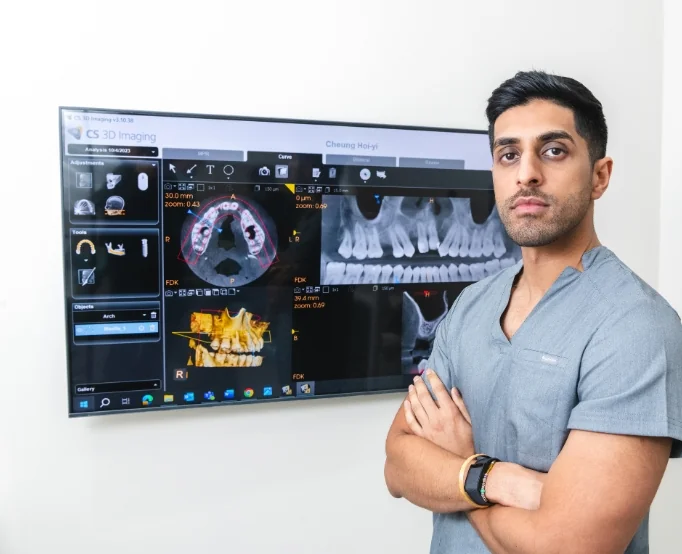
An implant needs enough healthy bone for support. A CBCT scan helps us decide whether grafting is needed or whether another implant position or treatment approach may be appropriate. We will explain any effect on cost and timescale before you decide.
What implants cost here
A single implant and crown starts from £2,500. Where clinically appropriate, a CBCT scan may be recommended as part of the planning process. We will explain any associated costs before treatment begins. If bone grafting is needed, this starts from £650.
How long implants last
With good daily cleaning and regular professional maintenance, dental implants are a well-established long-term way to replace missing teeth. Research summarised by the Association of Dental Implantology reports implant survival rates in excess of 90% after 15 years. Here, survival means the implant was still in place. Regular reviews and maintenance help look after the replacement tooth and the surrounding gum and bone. Your dentist will explain the factors that may affect your individual outlook.
Michael's experience with fixed teeth on implants
Michael had several loose and missing teeth before choosing fixed teeth supported by dental implants. His treatment involved multiple implants rather than a single-tooth implant. In this short video, he explains what the change meant for his eating and confidence.
Michael King shares his experience after fixed teeth supported by implants
Think an implant may suit you? Book a free implant consultation at Didcot Dental Studio.
If you are missing most or all of your teeth, you may be suitable for an approach where fixed temporary teeth are fitted on the day your implants are placed. Read more on our Teeth in a Day page.
When a bridge may be suitable
A bridge is a fixed replacement supported by one or more neighbouring teeth. A conventional bridge can be a practical choice where those teeth are already heavily filled or crowned. An adhesive bridge uses a wing bonded behind a neighbouring tooth and may require little or no drilling.
Unlike an implant, a bridge does not replace the missing root, and its long-term health also depends on the supporting teeth. Treatment usually takes several appointments over a few weeks. Prices start from £695 per unit. Read more about dental bridges.
When a removable denture may be suitable
A partial denture can replace several teeth without surgery and has a lower starting cost. Because it is removable, it can move more than a fixed replacement and may take time to get used to.
As the gum and jaw change following tooth loss, a denture may eventually need adjustment, relining or replacement. Partial dentures start from £750, and a full denture replacing all the teeth in one jaw starts from £900. Read more about dentures.
When implants can make a denture more secure
If a loose denture is the main problem, implants can be used to hold it more securely. An implant-retained denture clips onto attachments connected to implants in the jaw. A lower denture can often be retained by two implants, while an upper denture generally requires more; individual needs vary.
The denture still comes out for cleaning, and its attachments and fit require ongoing maintenance. However, it usually moves much less than a conventional denture and the implants help maintain the bone immediately around them.
What happens if a gap is left untreated?
A gap does not always need immediate treatment, but it is worth having it assessed. Depending on its position, neighbouring teeth can move and the bone can change after tooth loss. Some back-tooth gaps can be monitored when they do not affect chewing or the bite, and we will explain whether that is appropriate for you.
How we decide whether an implant is suitable
Your consultation is built around your needs rather than a one-size-fits-all recommendation. We consider:
- Your health and implant suitability. We assess your gums, healing factors, available bone and nearby anatomy.
- The gap, neighbouring teeth and bite. These help determine whether an implant, bridge or another treatment is clinically appropriate.
- Your priorities. We discuss whether you prefer fixed or removable teeth, together with the likely timescale and cost.
Find out whether a dental implant could work for you
Book a free implant consultation at Didcot Dental Studio. We will assess the gap, gums, neighbouring teeth and available bone, explain whether an implant is suitable and provide a written treatment plan with the costs clearly set out. If another treatment is more appropriate, we will explain why.
BOOK A FREE IMPLANT CONSULTATIONor call 01235 380888